Andrew Ross Sorkin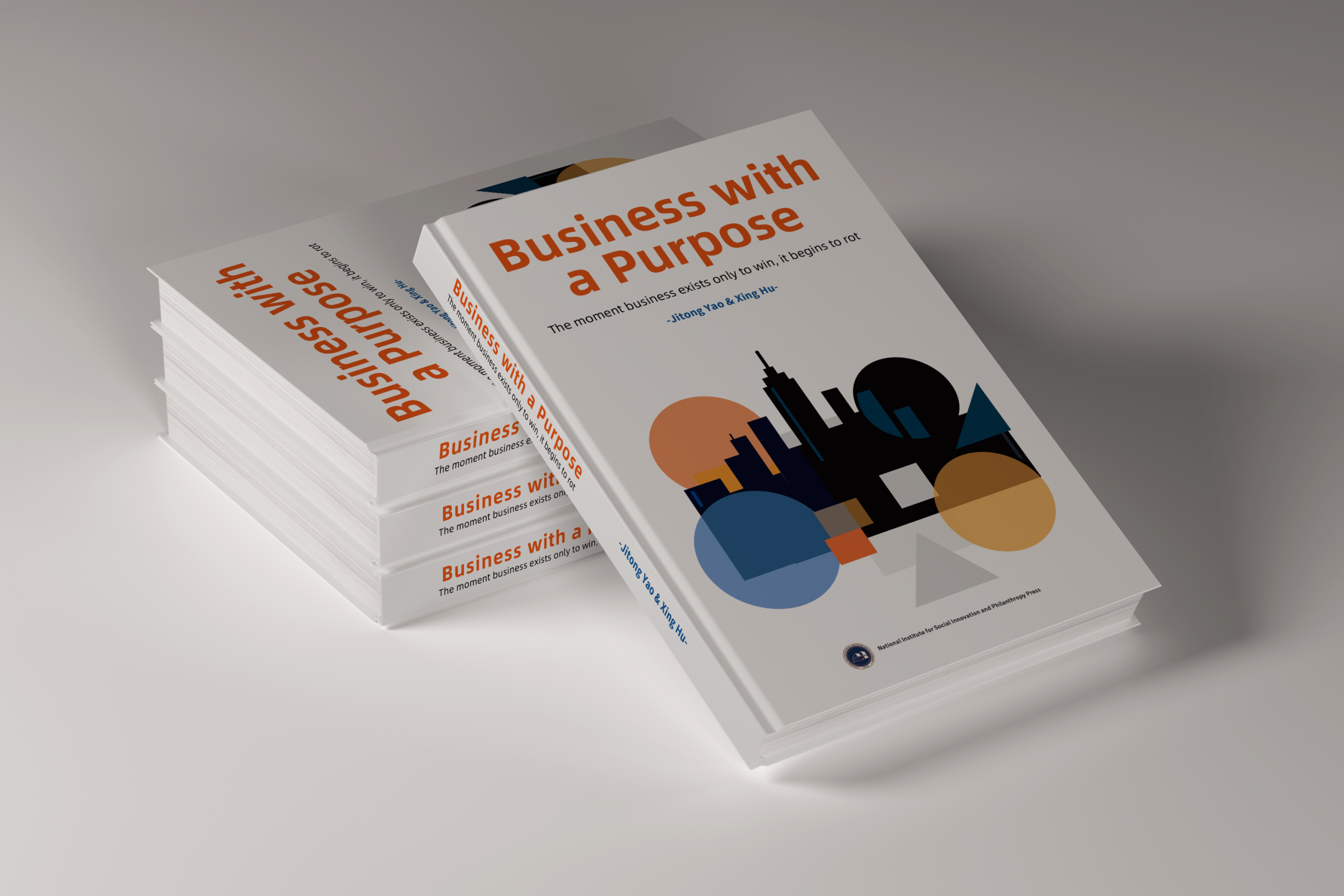
Business with a Purpose, the new book by Jitong Yao and Xing Hu, arrives at a moment when companies are being forced to answer a harder question than how much money they can make. The more important question now is whether they deserve to last.
The book is a bold and unusually timely argument about the future of enterprise. It does not treat purpose as a branding exercise, a philanthropic afterthought or another chapter in the ESG playbook. Instead, it presents purpose as a serious operating principle — one that determines how companies build trust, allocate capital, govern themselves and create value over time.
That is what makes the book stand out. Business with a Purpose is “One of the most original business books in years.” It is ambitious, intellectually sharp and grounded in the realities of modern business. More importantly, it gives business leaders a language for something many already sense: the old corporate manual is no longer enough.
The book’s central claim is straightforward but powerful. Profit remains essential, but profit alone is no longer sufficient. A company can grow quickly and still lose the trust of employees. It can dominate a market and still become politically, socially or reputationally fragile. It can produce strong financial returns while weakening the very systems — labor, communities, institutions, public confidence and environmental stability — on which long-term business depends.
Yao and Hu argue that the next generation of successful companies will be judged by a broader standard. They will need to show not only that they can compete, but that they can contribute. They will need to prove that their growth creates trust rather than consumes it. In this sense, the book is not a rejection of capitalism. It is a call for a more durable and more intelligent version of it.
The authority of the book comes in part from the very different backgrounds of its two authors. Jitong Yao brings the perspective of an entrepreneur, investor, philanthropist and scholar who has worked across education, technology, social innovation and public-interest organizations. According to the book’s author biography, Yao studied sociology at the University of California, Berkeley, completed a master’s degree in computer science at Harvard University and is pursuing doctoral research in information and innovation management at the University of Hong Kong. His work has focused on education philanthropy, social responsibility, sustainable development and public-interest governance.

Xing Hu brings a complementary academic and analytical perspective. She is an Associate Professor in Innovation and Information Management at HKU Business School, the University of Hong Kong, with research interests spanning operations management, platform economics, revenue management, digital systems and emerging technologies. She earned her Ph.D. from New York University’s Stern School of Business and holds a Bachelor of Science in Mathematics from Peking University.

The result is a book that combines field experience with institutional analysis. Yao writes with the urgency of someone who has built organizations and seen the limits of short-term business thinking. Hu brings the discipline of a scholar who understands systems, incentives, platforms and governance. Together, they produce a rare business book that is both visionary and practical.
One of the book’s most important ideas is corporate public-mindedness. The phrase does not mean that companies should simply donate more money or issue more polished responsibility reports. It means that a company should choose a real problem and build part of its business logic around solving it over the long term.
That distinction matters. Traditional corporate responsibility often begins after profit has already been made. Public-minded business begins earlier. It asks what problem the company exists to solve, who benefits from its growth, what social costs it creates and whether its model strengthens or weakens the environment around it.

In Yao and Hu’s framework, a public-minded company is not a charity. It is still disciplined, competitive and financially serious. But it understands that trust, legitimacy and long-term usefulness are not soft ideals. They are business capabilities.
A second major concept in the book is public-interest commercialisation. Here the authors turn their attention to nonprofits, foundations, social enterprises and public-interest organizations that often survive from one funding cycle to the next. The book argues that good intentions do not scale by themselves. Social missions need resource engines. They need structures that can sustain action beyond a campaign, a grant or a single wave of public attention.
This is one of the book’s strongest contributions. It refuses the simplistic idea that business and public good must sit on opposite sides of the table. Instead, it asks how commercial discipline can be used responsibly to help mission-driven work survive, grow and replicate. The point is not to turn public-interest work into ordinary profit-seeking activity. The point is to give important missions the infrastructure they need to endure.
The book’s third major theme is benefit-oriented infrastructure. Yao and Hu explore benefit corporations, contribution measurement, verified social contribution units and benefit-token concepts as part of a broader effort to make social contribution visible, credible and repeatable. Their argument is that public value cannot remain vague if it is to become part of the future of business. It must be measured, verified and governed.

This is where Business with a Purpose becomes more than a conventional leadership book. It reads less like motivational commentary and more like a design brief for the next generation of enterprise. The authors are not merely asking executives to care more. They are asking how responsibility can be built into systems — into governance, incentives, reporting, partnerships and capital allocation.
The book is especially relevant for founders, CEOs, board members and investors. For entrepreneurs, it offers a warning against building companies that can scale but cannot be trusted. For executives, it explains why mission cannot remain trapped in marketing language. For investors, it provides a framework for thinking about durability, governance risk and long-term enterprise value. For nonprofit and social-impact leaders, it offers a path beyond dependency on donations and short-term funding.
It is also a valuable read for younger professionals and business students. The next generation of talent is not only asking what a company pays. It is asking what a company stands for. Employees increasingly understand that joining a company means joining a system of values, incentives and consequences. Business with a Purpose explains why that shift matters and why companies that ignore it will struggle to attract and retain serious talent.
The technology sector, in particular, should pay attention. AI companies, platform businesses, fintech firms, education companies, health startups and digital marketplaces all face a version of the same challenge: scale creates power, and power creates responsibility. The larger a platform becomes, the harder it is to pretend that its social effects are external to the business. In the digital economy, public trust is not optional. It is part of the license to operate.
The book is strong because it is unsentimental. It does not flatter business leaders with easy talk about values. It does not suggest that purpose can be solved with a campaign, a slogan or a report. It tells companies something more difficult: if they want to survive the next era, they must become more useful, more accountable and more structurally honest about their role in society.
That message gives the book its force. Business with a Purpose is not asking companies to be less ambitious. It is asking them to be ambitious in a larger way. The most valuable companies of the future may not be those that extract the most value from the world, but those that help organize, repair and strengthen the systems on which business itself depends.
For readers looking for a simple inspirational business story, this is not that book. For readers looking for a serious framework for the future of enterprise, it is exactly that. It is best suited for founders building companies they want to last, executives responsible for governance and strategy, investors evaluating long-term resilience, social-impact leaders seeking sustainable models and students trying to understand where business is going next.
The conclusion is clear. The future will not belong only to companies that win. It will belong to companies that deserve to endure.
Business with a Purpose is bold, original and highly relevant. It captures one of the defining business questions of our time: how can companies create profit without destroying trust, and how can purpose become not a slogan, but a system?