Andrew Ross Sorkin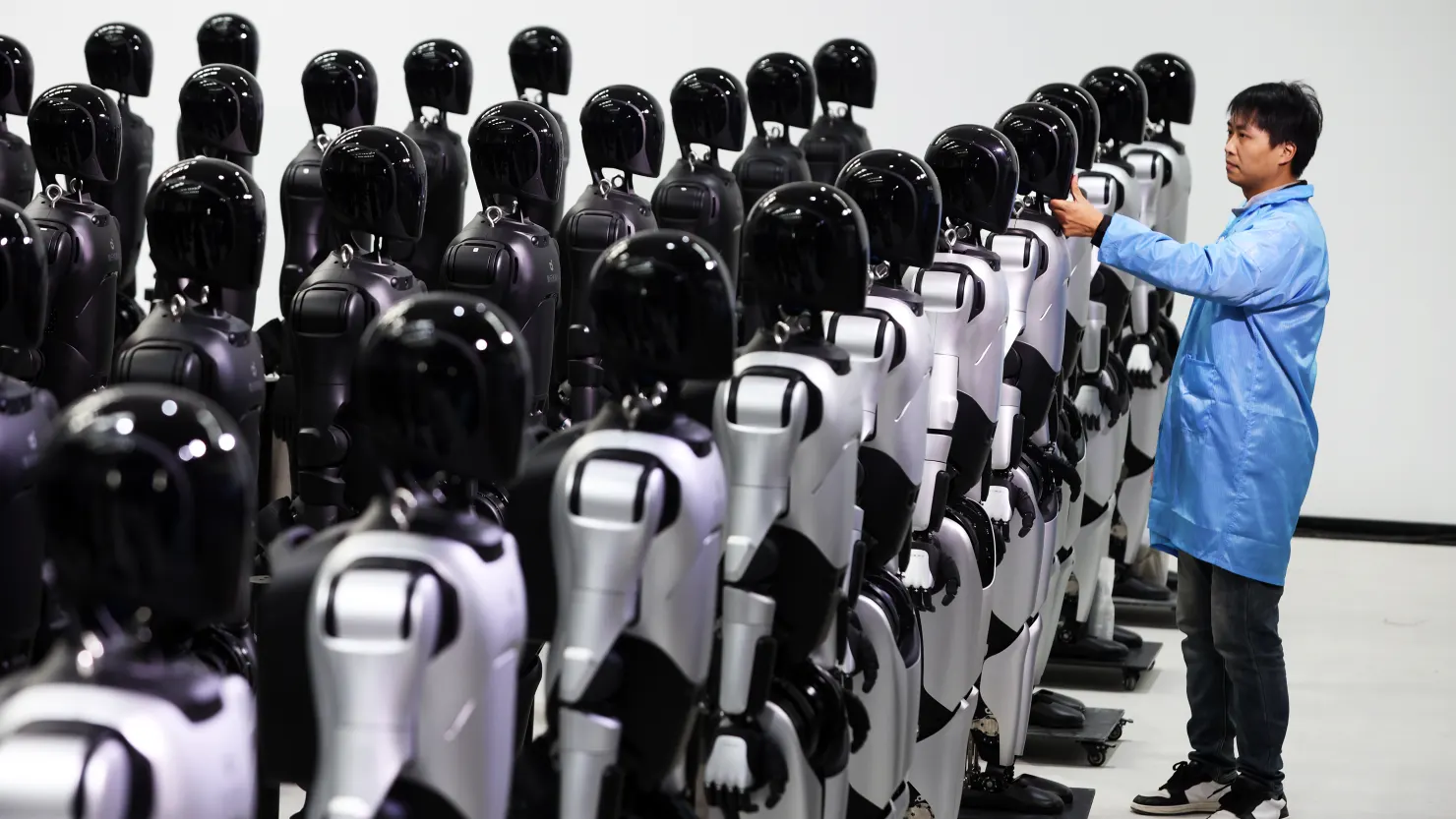
This year, billionaire Elon Musk has brought humanoid robots into the spotlight, presenting them as a key element in Tesla’s valuation, which he predicts could reach tens of trillions of dollars. However, Tesla has yet to sell its flagship humanoid robot, Optimus.
Instead, it appears that several Chinese companies are likely to surpass Tesla in bringing humanoid robots to the market, with production expected to scale up by 2026, as China positions the technology at the heart of its strategic initiatives.
“China is currently ahead of the U.S. in the early commercialization of humanoid robots,” Andreas Brauchle, a partner at consultancy Horváth, told CNBC via email. “While both countries are expected to develop similarly large markets over time, China is moving faster in this initial phase.”
Humanoid robots are designed to resemble humans in shape and movement. Their functions are powered by artificial intelligence algorithms and advanced hardware such as semiconductors. Advocates suggest these robots could be deployed across multiple sectors, from manufacturing and hospitality to residential environments.
China Prioritizes Robotics
In recent years, China has made robotics a central focus of its technology strategy, unveiling plans to build robust supply chains and enable mass production of humanoid machines.
In October, Chinese President Xi Jinping and the nation’s top leadership released proposals as part of the “15th Five-Year Plan,” outlining key areas of technological and economic focus for the coming years. The plan explicitly mentions “embodied artificial intelligence,” referring to AI-driven physical systems like robots and autonomous vehicles.
Humanoid robots are seen as a solution to China’s labor challenges and a tool to bolster its position in the global tech race.
“China’s drive toward humanoid robotics is motivated by demographic pressures, ambitions for the next wave of economic growth, and the desire to strengthen its role in global competition,” Karel Eloot, senior partner at McKinsey & Company, told CNBC.
With declining birth rates and an aging population, the Chinese workforce is shrinking, and labor costs are rising. Robots are expected to help alleviate these pressures. Meanwhile, the U.S. and China are competing across multiple technology sectors, and robotics—being a tangible application of AI—could emerge as a major battleground by 2026. According to Politico, U.S. Commerce Secretary Howard Lutnick has met with robotics company executives to formulate a strategy, and Washington may issue an executive order on robotics next year.
Leading Chinese Robotics Companies
“China could become the most significant market for humanoid robots,” RBC Capital Markets noted in a recent report, predicting a global addressable market of $9 trillion by 2050, with China capturing more than 60% of that.
Several Chinese firms are advancing rapidly in humanoid production. Unitree, preparing for an IPO potentially valuing the company at $7 billion, is one of the country’s most prominent robotics firms, offering multiple models including humanoids. Its latest H2 model, showcased this year, demonstrated its dancing capabilities.
UBTech Robotics is another major player, producing humanoids for industrial use as well as commercial roles, such as tour guides. Its flagship industrial robot, the Walker S2, can replace its own battery to operate around the clock. UBTech, listed on the Hong Kong Stock Exchange, recently raised approximately $400 million to expand operations. The company plans to deliver 500 industrial robots this year and scale humanoid production to 5,000 units in 2026 and 10,000 in 2027.
AgiBot also reported this month that it produced its 5,000th humanoid. Meanwhile, Chinese electric vehicle maker Xpeng introduced its second-generation humanoid, Iron, and intends to begin mass production next year. In total, China hosts over 150 humanoid robotics companies, though these are among the most influential.
China vs. U.S.: Competing Advantages
Analysts note that China’s manufacturing capabilities, proven in sectors like electric vehicles, may give it an advantage in robotics.
“The depth of China’s supply chain allows companies to develop and produce robots at a significant cost advantage compared to other regions,” Ethan Qi, associate director at Counterpoint Research, told CNBC. UBTech expects production costs to decline 20% to 30% annually. Additionally, local Chinese governments offer subsidies to support robotics companies.
The U.S., however, maintains an edge in AI, autonomy, and advanced algorithm development, according to Horváth’s Brauchle. American firms are pursuing vertical integration, controlling more of the supply chain, including actuators and AI software. McKinsey’s Eloot explained that this approach can deliver better performance, improved safety, and defensible intellectual property.
Brauchle predicts that while China’s humanoid market will initially surpass the U.S., both countries are expected to converge in size over time, with mass-market adoption occurring after 2040, especially in private households.
Industry Challenges
China’s robotics industry faces several hurdles. One major constraint is limited access to critical chips, such as Nvidia processors, which are essential for advanced robot functionality. AI limitations in unpredictable environments and regulatory obstacles are also slowing commercialization.
Reproducing human limb movements remains a complex technological challenge. Most robotic hands still lack the degrees of freedom necessary to fully mimic human capabilities. Cost is another significant barrier: current humanoid prototypes can range from $150,000 to $500,000 per unit, but prices need to fall to $20,000–$50,000 to compete with human labor effectively.
Investment Bubble Concerns
Despite robotics being a strategic priority, Chinese regulators have warned about a potential market bubble. The National Development and Reform Commission noted the rapid growth of humanoid robotics firms and the similarity of many products. Past technology sectors prioritized by Beijing, such as electric vehicles, have experienced boom-and-bust cycles.
“Many assume humanoid robots will soon surpass human capabilities in versatility and autonomy. Demonstration videos and trade-show performances often exaggerate what is achievable in real industrial settings,” Brauchle said. This perception gap increases the risk of overinvestment. Forrester’s Dai added that a market correction could slow both innovation and commercialization progress.