Andrew Ross Sorkin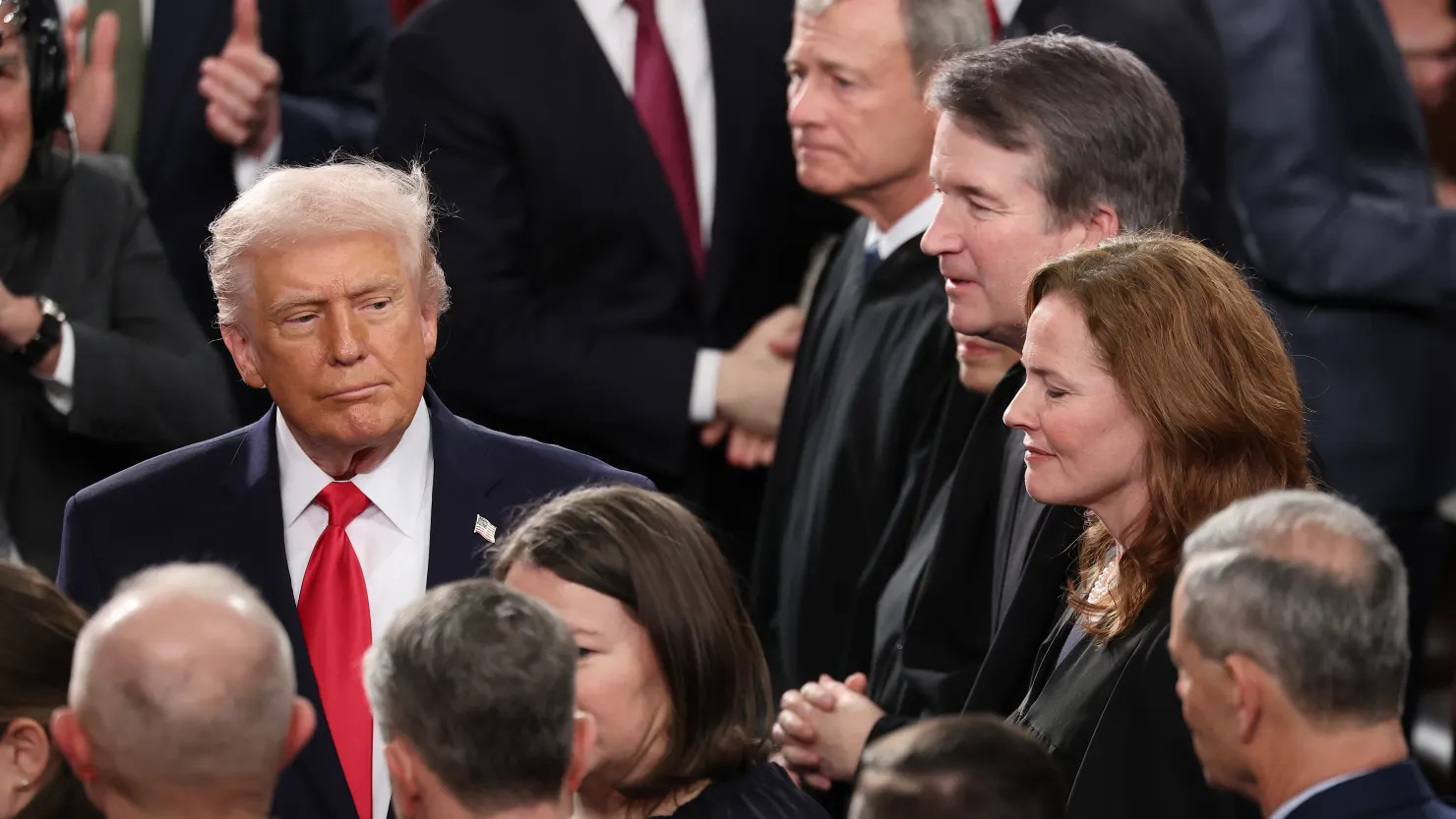
President Donald Trump used his State of the Union address this week to vigorously defend his tariff-driven trade strategy, even as a recent Supreme Court decision has complicated the legal foundation of many of his administration’s policies and agreements.
Just days before the speech, the U.S. Supreme Court ruled that the president had overstepped his authority by imposing sweeping tariffs under the International Emergency Economic Powers Act (IEEPA). The administration had relied on IEEPA to justify duties on imports from nearly every country, framing the measures as necessary responses to national economic threats. The court concluded that this use of emergency powers exceeded the scope intended by Congress.
Despite the ruling, Trump signaled that he would continue pursuing tariffs within what he described as lawful boundaries. Almost immediately after the decision, his administration replaced the invalidated emergency tariffs with a new 10% universal tariff under Section 122 of the Trade Act of 1974, which took effect Tuesday. Trump has also floated the possibility of raising that rate to 15% under the same provision, though no clear timeline has been provided.
The legal shift has sent ripples through global markets and foreign capitals. Many bilateral agreements negotiated over the past year were structured around tariff rates imposed under IEEPA. With that legal basis removed, trading partners are now reassessing both the durability and the value of the concessions they made.
Johannes Fritz, chief executive of the St. Gallen Endowment for Prosperity through Trade, noted that numerous governments agreed to specific terms in exchange for preferential tariff treatment that depended on IEEPA authority. With that framework struck down, the underlying logic of those deals is now uncertain. Reconstructing similar arrangements under other statutes, such as Section 301, would require fresh investigations and new legal procedures, a process that could take considerable time.
Section 301 of the Trade Act of 1974 authorizes the U.S. Trade Representative to investigate alleged unfair trade practices before tariffs can be imposed. Unlike IEEPA, it demands a formal inquiry and procedural steps that limit the administration’s flexibility and speed.
The ruling has also reshuffled the perceived winners and losers of last year’s trade negotiations. Sarang Shidore of the Quincy Institute’s Global South Program observed that countries that moved quickly to strike deals with Washington following last year’s “Liberation Day” tariff announcements may now feel disadvantaged. By contrast, nations that resisted U.S. pressure could feel vindicated.
Alicia Garcia Herrero, chief economist for Asia-Pacific at Natixis, pointed to Japan as a case in point. In 2024, Tokyo agreed to a deal that reduced reciprocal tariffs to 15% in exchange for a $550 billion investment commitment in the United States. Now, with the emergency tariff framework invalidated and replaced by a broad 10% rate, Japan may find itself paying a premium for treatment that is no longer unique.
Japan’s trade minister, Ryosei Akazawa, warned this week that the new universal tariff could increase costs for certain Japanese exports. He urged Washington not to place Japan at a disadvantage compared to terms negotiated last year, signaling Tokyo’s concern that previously settled arrangements could unravel.
Uncertainty is also clouding other major negotiations. During his address, Trump asserted that most countries and corporations wished to maintain the agreements they had already reached before what he characterized as the Supreme Court’s “unfortunate involvement.” However, developments abroad suggest a more cautious response.
India recently paused plans to finalize an interim trade deal just days before a scheduled visit to Washington. Trade Minister Piyush Goyal indicated that New Delhi would resume discussions once there is greater clarity about the U.S. tariff regime.
In Europe, the European Parliament delayed a vote—again—on a proposed agreement that would have locked in a 15% U.S. tariff rate on most EU goods while removing European duties on a range of American imports, particularly industrial products. Bernd Lange, chair of the parliament’s international trade committee, said U.S. actions appeared to breach the spirit, if not the letter, of last year’s understanding. EU officials have warned that if Washington fails to clarify its position, the bloc could consider retaliatory measures. Lawmakers are expected to revisit the issue in early March to determine whether the United States remains committed to the previous framework.
Canada responded more positively to the court’s decision. Regional leaders in British Columbia and Ontario described the ruling as a constructive step. Ontario Premier Doug Ford argued that Washington’s leverage may be weakening and suggested that accepting no deal could be preferable to agreeing to unfavorable terms.
Trump, for his part, has warned against any attempt by trading partners to walk away from earlier agreements. He has said that countries seeking to “play games” could face even higher tariffs under alternative trade statutes. In a post on Truth Social, he also raised the possibility of imposing licensing fees on foreign exporters. Meanwhile, U.S. Trade Representative Jamieson Greer indicated that the administration may launch new Section 301 investigations against several countries, potentially paving the way for fresh duties.
Elsewhere, leaders appear to be adopting a wait-and-see approach. Mexican President Claudia Sheinbaum said her government would closely examine the scope and implications of the Supreme Court’s ruling before adjusting its strategy. China’s Ministry of Commerce stated that it would engage in what it described as honest negotiations during the next round of bilateral talks, expected to coincide with Trump’s planned visit later next month. Beijing also said it would comprehensively evaluate any new developments in Washington before deciding whether to modify its countermeasures to U.S. tariffs, including those linked to fentanyl-related concerns.
As foreign governments weigh their options, attention is turning to what some observers are calling a potential “Plan B” in Washington. With IEEPA no longer available as a blanket justification for emergency tariffs, the White House is exploring other legal pathways to sustain its trade agenda.
Jennifer Hillman, a senior fellow at the Council on Foreign Relations, noted that the administration has negotiated various trade-related agreements and frameworks with eighteen countries. However, none are fully binding or finalized, and none have been formally approved by Congress. As a result, both the tariff landscape and the bargaining positions of all parties remain fluid.
The administration has signaled it may rely more heavily on Section 301 investigations or on Section 232 of the Trade Expansion Act of 1962, which permits tariffs on imports deemed threats to national security. Both routes are legally viable but procedurally more demanding than the broad emergency powers previously invoked.
For now, the global trading system is navigating a period of heightened uncertainty. Legal constraints have narrowed the president’s immediate authority, yet the administration retains several tools to pursue its objectives. Whether those tools can deliver the same leverage—or generate new friction—will shape the next phase of U.S. trade policy and its impact on the global economy.