Andrew Ross Sorkin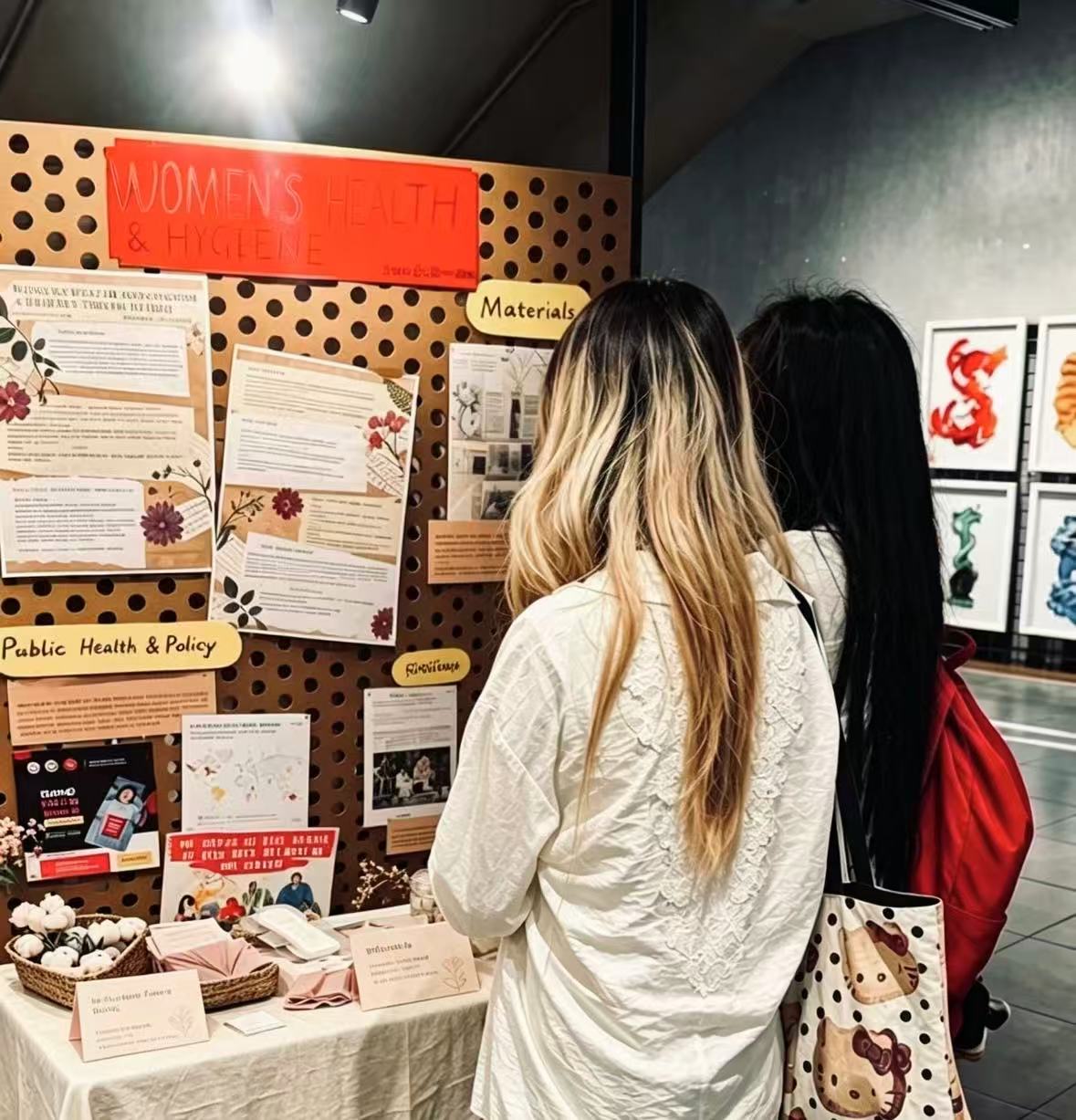
At Shenzhen College of International Education, an exhibition tracing women's health and hygiene from 3000 BCE to the present connects the history of materials and manufacturing with questions of access, health education and social attitudes.
Cotton, pieces of fabric, sanitary products and printed cards cover the exhibition table. Behind them, a timeline runs across several display boards. Visitors stop to read, lean in to compare sections and point out details to one another. The objects are familiar; the setting makes them look different.
The exhibition, "Women's Health and Hygiene: A Journey Through Time," was created by Momo Zha, a student at Shenzhen College of International Education (SCIE). Beginning at "3000 BCE – Present," it follows changes in women's hygiene across different historical periods through written research, thematic panels, material samples, everyday products and in-person discussion.
The subject is intimate by nature, but the exhibition treats it as part of a much wider history. Rather than presenting modern sanitary products in isolation, it places them alongside changes in materials, manufacturing, health knowledge and social attitudes. The result is a display about everyday life as much as it is about products.
What stands out is the decision to make an ordinary, often private subject visible in a shared space. The exhibition does not rely on spectacle. Its argument is built through chronology, objects and the connections between them.
That structure gives the audience a clear way into the topic. The early sections look at the period before modern sanitary products existed; later sections move through the Industrial Revolution, the twentieth century and the modern era. Across the timeline, the same questions keep returning: what materials were available, how products were made, what people knew about health, and how social conditions shaped everyday practice.
Seen this way, the history of women's hygiene is also a history of how technological and social change reaches daily life.

An ordinary object, placed in history
Modern sanitary products are designed to disappear into routine. They are bought, used and replaced, and their familiarity can make the long history behind them easy to miss. Zha's exhibition begins by restoring that history.
The early-history section returns to a time before modern sanitary products. With limited materials, different living conditions and different levels of health knowledge, people relied on cloth and other available absorbent materials to meet personal hygiene needs. The display places those practices alongside cultural ideas and medical understanding, showing that material choices were never separate from the societies in which they were used.
That approach changes the meaning of the objects on display. A piece of cloth is not presented simply as an old alternative to a modern product. It becomes evidence of what was available at a particular time, what people knew, and how they responded to a basic health need with the resources around them.
The nineteenth century marks a major shift in the timeline. As textile production and manufacturing developed during the Industrial Revolution, new materials increasingly entered everyday goods. On the display, Technology, Manufacturing, Accessibility and Hygiene appear together, linking technical change with the way products reached ordinary life.
The sequence is important. New materials made different forms of hygiene products possible; manufacturing shaped how those products could be produced; accessibility determined how widely they could be used. By putting these elements side by side, the exhibition moves away from a simple story of invention and toward a broader account of how products become part of daily practice.

Industrial change also changed daily life
By the twentieth century, the story had shifted again. Improvements in materials and the growth of standardized production changed the form and availability of women's hygiene products. Commercialization brought greater consistency and convenience, while the subject of women's hygiene increasingly entered conversations about health education, work and public health.
The exhibition treats those developments as connected rather than separate. Product design changed, but so did the environments in which products were used. The twentieth-century section therefore sits at the point where manufacturing history begins to overlap more visibly with questions about health knowledge and participation in everyday public life.
The modern section widens the frame further. It notes the greater range of materials and design choices now available, while drawing attention to health, comfort, accessibility and sustainability. The display also recognizes that access to products, health education and related services can still differ among groups.
That is where a history of objects becomes a public-health question. The existence of a product is only one part of the picture. People also need information, practical access and social conditions that allow health needs to be addressed openly and appropriately.
The exhibition makes that transition quietly. There is no sharp break between the historical and modern sections. Instead, the visitor moves from one period to the next and sees the subject expand: first materials, then production, then education, access and social context.

From products to public health
The chronological timeline is only one part of the display. Alongside it are thematic sections labeled Materials, Public Health & Policy and Society. These panels reorganize the same subject around the forces that shape it.
Materials focuses attention on how physical substances and design affect hygiene products. Society looks at social attitudes and everyday life. Public Health & Policy moves the discussion toward health education, access to resources and the wider environment in which people seek information and support.
Placed together, the sections show why women's hygiene cannot be understood only through product design. Materials influence function. Manufacturing influences what can be produced at scale. Health education shapes what people know. Access determines whether knowledge and products are available in practice. Social attitudes affect whether the subject is discussed openly or kept largely private.
This wider framing is especially relevant to a topic grounded in the body. Hygiene is experienced individually, but the conditions surrounding it are collective. Products are manufactured within industries; health information is shared through institutions and communities; social attitudes develop over time. The exhibition brings those layers into the same visual field.
The effect is strongest when the visitor can move directly between the thematic panels and the objects on the table. A material sample can be read alongside a section on technology. A modern sanitary product can be considered next to a discussion of accessibility. The physical object gives the broader topic a concrete point of reference.
Instead of asking the audience to begin with an abstract social issue, the exhibition begins with something recognizable and then gradually opens the question outward.

Why the physical display matters
The table in front of the boards is central to the way the exhibition communicates. Cotton, textiles, sanitary products and explanatory cards are arranged as part of the argument, not as decoration. They allow visitors to move back and forth between written history and material evidence.
For a topic covering several thousand years, that physical layer helps prevent the timeline from becoming a sequence of dates. Materials give scale and texture to the story. They also remind the viewer that historical change is eventually experienced through ordinary things: what people can obtain, what they use, and what they understand about their own health.
The display can be read in more than one direction. A visitor may follow the chronology from early history to the modern era, or begin with a thematic panel on Materials, Society or Public Health & Policy. The structure accommodates both approaches without losing the central thread.
That flexibility is visible in the photographs from the event. Some visitors read the boards closely; others focus on the table or discuss a particular section with someone beside them. The exhibition becomes less like a single poster to be viewed from a distance and more like a small environment for reading and conversation.
The arrangement also gives the audience room to notice different things. One person may be drawn to the history of materials, another to the change in manufacturing, and another to questions of access or health education. Those routes converge on the same subject, but they do not require everyone to enter it in the same way.

When a private subject becomes discussable
Women's health occupies a complicated place in everyday life. It is widely relevant, yet many of its most immediate experiences remain personal. Sanitary products are common, but the history and social conditions behind them are rarely part of ordinary conversation.
The exhibition changes that setting by placing the subject in public view in a factual, measured way. Historical material sits beside products and samples; health and access are discussed alongside manufacturing and society. Women's hygiene is treated as a subject that can be studied, displayed and talked about openly.
Here, the shift is modest but visible. A topic usually encountered in private life is placed on a board, supported by objects and materials, and opened to questions from other people. The discussion grows out of the display itself rather than being imposed on it.
The final panels make that shift explicit. Under "Why Does It Matter?" and "Reflection," the exhibition asks visitors to reconsider products and health ideas that now feel ordinary, and to think about the combined influence of science, materials, culture, education and access on individual health experience.
By that point, the timeline has changed the way the familiar objects are read. A sanitary product is no longer only a consumer item; it is also the end point of changes in materials, manufacturing and health knowledge. A cotton sample is no longer simply part of the table arrangement; it is connected to a much longer history of how people met practical hygiene needs.
The conversation at the display reflects that change in perspective. Visitors point to specific sections, compare information and exchange views. The project therefore moves beyond one-way presentation and becomes a shared reading of the subject.
Research made public
Behind the finished display is a second story: how research is turned into something another person can follow in a public setting. The exhibition required information to be selected, organized and given a visual structure. Historical material had to be placed in sequence; thematic material had to be connected to that sequence; physical samples had to support rather than distract from the argument.
For a student project, those decisions are part of the research itself. Collecting information is only the beginning. Another task is deciding which facts belong together and which relationships should be made visible. In this case, the final structure connects history with materials, materials with manufacturing, manufacturing with accessibility, and accessibility with health and social life.
The display also has to be legible to people who did not take part in the research. That shapes the writing and the layout. Short sections, clear headings, a visible timeline and physical objects let visitors follow the argument while moving through the exhibition.
The photographs show visitors pausing, reading and talking. Some focus on particular details while others take in the full timeline. The project functions both as a research presentation and as a form of public communication.
For Zha, the final exhibition brings several kinds of work into one space: historical research, information selection, visual organization, material display and face-to-face explanation. None of those elements stands alone. Together they determine whether the subject can be understood by someone encountering it for the first time.
What the exhibition leaves with its audience
The most memorable part of the project is not a single date or product. It is the change in scale that takes place as the visitor moves through the display. The exhibition begins with a familiar aspect of daily life and gradually reveals the systems around it.
Early materials point to the limits and possibilities of their time. Industrialization introduces manufacturing and wider availability. The twentieth century brings standardization and commercialization. The modern era adds questions of health, comfort, accessibility and sustainability. The thematic panels then pull those strands together through materials, society and public health.
Seen in that sequence, technological change is no longer remote. It appears in the products people use and in the routines those products make possible. Social change becomes visible in another way: in the language used to discuss women's health, in the availability of information and resources, and in whether a subject once kept largely private can be examined openly in a school setting.
The exhibition also shows why everyday objects can be useful starting points for research. They are easy to recognize, but they are rarely simple. Their materials come from particular technologies; their forms reflect manufacturing choices; their use depends on knowledge and access; their meaning changes with social attitudes.
For Momo Zha, that set of connections turns a chronological exhibition into something broader than a product history. It becomes a way of reading the relationship between bodies and the systems that surround them.
The visitors gathered around the boards offer the clearest indication of what that approach can do. A topic rooted in private experience is no longer confined to private routine. It has been given a form that others can examine together.
By the end of the route, the exhibition returns the viewer to the same kinds of objects with which it began: cotton, fabric and sanitary products. They remain ordinary things, but the timeline has attached a history to them: changing materials, manufacturing, health knowledge and access.
Around the boards, visitors continue to read and talk. For a subject that often remains folded into private routine, being examined in a shared space changes the way it is seen.