Andrew Ross Sorkin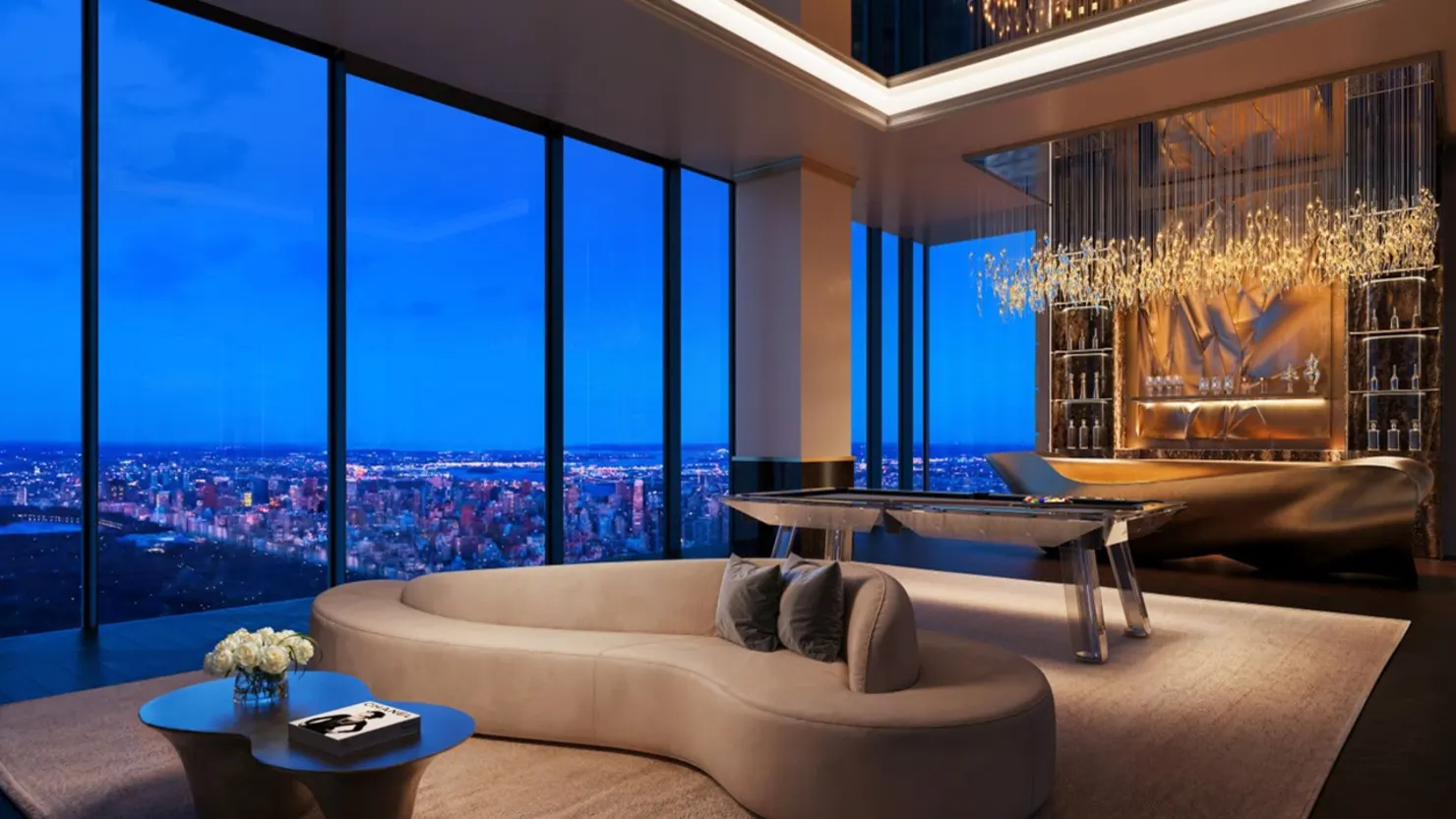

As the Dow Jones Industrial Average tumbled and global markets reacted to new tariff developments, another figure was capturing attention in Manhattan: a newly listed $110 million penthouse, now the priciest property on the New York City market.
The listing went live on April 3, amid one of the most volatile weeks in Wall Street history. On that day, the Dow dropped 1,679 points, a 4% loss, followed the next day by another 2,231-point plunge. Market turbulence has persisted since, driven by ongoing trade policy uncertainty.
Yet, according to Nikki Field, the Sotheby’s International Realty broker handling the Manhattan listing, these swings haven’t affected her potential buyers.
“This segment of buyers is largely unaffected by market volatility,” Field said. “They don’t react to headlines or day-to-day market shifts. Their focus remains on building world-class portfolios, and ultra-prime residential real estate continues to be a cornerstone for them.”
The property in question is an exceptional offering atop the iconic Steinway Tower at 111 West 57th Street. Penthouse 80 and Penthouse 82 are being marketed together as a potential quadplex, encompassing the tower’s top four floors, each with private elevator access. Together, they span 11,480 square feet, offering five bedrooms, six bathrooms, multiple lounges, and a 618-square-foot terrace with panoramic views of Central Park and both rivers flanking Manhattan.
“Although the residences are currently separate, their architectural potential as a combined quadplex is the main attraction,” Field explained.
Sotheby’s notes that neither unit has ever been publicly listed or marketed individually. Since the quadplex listing launched, Field reports strong buyer interest.
“Several highly qualified individuals have already toured the property. There’s real momentum in the market,” she said.
The Real Deal reported that Field and her team assumed sales at 111 West 57th Street in July, replacing Corcoran Group and marking the third brokerage to handle the building since its 2018 debut.
Penthouse Premium
Jonathan Miller, a real estate appraiser and consultant with Miller Samuel, told CNBC that nine-figure listings, once largely viewed as publicity stunts, are increasingly serious sales.
“U.S. homes priced over $100 million now average about four sales per year,” he said. “We saw nine in 2021 and eight in 2024, which is remarkable.”
Last year, New York recorded just two such nine-figure sales: a $135 million penthouse at the Crown Building purchased by billionaire Vladislav Doronin, and a $115 million Central Park Tower penthouse bought by Extell founder Gary Barnett.
One of the most notable examples remains Ken Griffin’s 2019 purchase of a 24,000-square-foot quadplex at 220 Central Park South, the most expensive home ever sold in the U.S., at $238 million.
For perspective, Griffin’s acquisition came to about $10,420 per square foot, while the $110 million listing at 111 West 57th Street, at 11,480 square feet, is roughly $9,578 per square foot.
Still, Miller cautioned against overinterpreting these high-profile sales: “They are one-off transactions and should not be seen as reflective of the broader luxury housing market.”
Shifts in the High-End Market
While Field remains optimistic about ultra-prime demand, some brokers report more caution in the wider luxury market.
A recent Wall Street Journal article noted that many high-end buyers are stepping back amid economic uncertainty.
“The absence of a clear tariff strategy has created hesitation,” Miller said. “This is likely to slow housing activity.”
Realtor.com’s 2025 High-End Housing Market Trends report highlights that the wealthiest 10% of Americans hold the bulk of their wealth in stocks—36.3% in corporate equities and mutual funds—while real estate accounts for 18.7%.
“No one likes uncertainty, and that’s the worst enemy for real estate right now,” said Noble Black, a luxury broker with Douglas Elliman in New York City. “Some clients think tariffs could push inflation up and increase property values, while others see it as a chance to move out of financial markets and into tangible assets like real estate.”
Still, the high-end market shows signs of resilience.
The Olshan Luxury Market Report, which tracks Manhattan homes priced above $4 million, recorded 33 contracts signed between April 14 and April 20, up from 29 the previous week.
“It was a surprisingly strong performance for the luxury segment, particularly given market volatility and the holiday period,” noted Donna Olshan.
In Los Angeles, Christie’s International Real Estate broker Aaron Kirman observed a split between buyers and sellers.
“Buyers are cautious, while sellers are holding out for 2020-2021 pricing,” he said. “This gap determines whether deals succeed or fail.”
Some sellers, he added, are quietly adjusting prices for select buyers rather than publicizing cuts, aiming to remain competitive without damaging perception.
Buyers, meanwhile, are becoming more strategic, favoring all-cash offers, straightforward terms, and extended inspection periods. “Negotiation is sharper on price, furnishings, and closing flexibility,” Kirman said.
He also noted that cautious buyers are lengthening transaction timelines. “Deals that used to close in three to six months may now take nine to 12, unless the estate is turnkey,” he said. “Patience is key.”
In South Florida, Douglas Elliman broker Senada Adzem emphasized that the luxury market isn’t declining, but evolving.
“Buyers in the $5 million to $10 million range are meticulous, comparing properties and assessing whether each meets their lifestyle expectations,” Adzem said.
For properties above $20 million, priorities shift.
“High-end buyers pursue rare, trophy assets—irreplaceable waterfront homes or unique estates,” she said. “When the right opportunity arises, price matters but isn’t the main consideration. At the ultra-luxury level, it’s about securing a one-of-a-kind property for long-term legacy.”