Andrew Ross Sorkin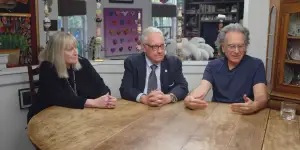
When Peter Buffett first realized that he and his siblings would one day be responsible for distributing the vast fortune of their father, legendary investor Warren Buffett, his instinctive reaction was resistance rather than excitement.
“I didn’t want the responsibility,” Peter Buffett once told CNBC. He recalled calling his father and saying that he wanted to step aside. Warren Buffett’s response was understanding. He acknowledged the immense pressure such a role would place on his children and did not fault his son for feeling overwhelmed.
In 2024, Warren Buffett publicly confirmed that after his death, the majority of his wealth would be transferred to a newly created charitable foundation overseen by his three children: Susan A. Buffett, commonly known as Susie; Howard G. Buffett, known as Howie; and Peter Buffett. At the time of the announcement, the 95-year-old billionaire’s net worth was estimated to exceed $150 billion, according to Bloomberg, and it has continued to grow since then.
What makes this plan especially daunting is not only the size of the fortune, but also the conditions attached to it. Warren Buffett has asked that the entire sum be donated within ten years of his passing. In addition, every major decision about where the money goes must be approved unanimously by all three siblings. No single heir can act alone.
The scale of this commitment is unprecedented. To meet the ten-year deadline, the Buffett children would need to distribute at least $15 billion annually. Based on data from Giving USA through 2024, that figure represents roughly 4 percent of all charitable donations made in the United States each year. If Warren Buffett’s wealth continues to increase, the annual amount could become even larger.
“It’s something no one has really done before, especially not as a family,” Howie Buffett has said. Susie Buffett has summed it up more simply: the sheer volume of money is hard to fully comprehend.
As a result of this decision, the Buffett siblings—who have largely stayed out of the public eye—will inevitably become some of the most influential philanthropists in the world. After their father’s death, they are likely to face intense scrutiny from the media, close attention from other major donors, and an overwhelming number of funding requests from organizations across the globe.
In a rare joint interview with CNBC’s Becky Quick, the three siblings explained that their approach to money and philanthropy was shaped early on at home. Although their father’s wealth grew steadily during their childhood, their lifestyle remained modest by billionaire standards. They attended public schools, rode the bus, did household chores in exchange for allowance money, and held part-time jobs.
Warren Buffett drove a blue Volkswagen Beetle during those years, and extravagance was never encouraged. Their mother, Susan T. Buffett, was deeply involved in volunteer work and regularly hosted exchange students from different countries. Susie Buffett recalls a childhood moment that illustrates just how ordinary their household felt. When she was asked to list her parents’ occupations on a school census form, her mother told her to write “security analyst” for her father.
“At the time, I thought he fixed burglar alarms,” Susie Buffett has said.
As adults, each of the Buffett children built their own lives, families, and philanthropic interests. Their growth as donors was also supported by their father’s long-term strategy. Beginning in 2006, Warren Buffett started donating shares of Berkshire Hathaway annually to foundations run by each of his children. Over nearly two decades, this gave them hands-on experience managing large-scale philanthropy well before they were tasked with distributing the remainder of his fortune.
Today, Susie Buffett lives in Omaha, Nebraska, and focuses primarily on early childhood education, reproductive health, and social justice through the Susan Thompson Buffett Foundation and the Sherwood Foundation. Howie Buffett, based in Illinois, leads the Howard G. Buffett Foundation and concentrates much of his work internationally, especially on food security, agricultural development, and conflict resolution. Peter Buffett, who lives in upstate New York, heads the NoVo Foundation, which supports programs focused on the health, safety, and economic empowerment of women and children.
Despite the enormous trust placed in them, the siblings say their father has given them remarkably few instructions about how to use the money. According to Peter Buffett, the only clear directive is that the funds should help people who are “less fortunate.” In his 2024 Thanksgiving letter, Warren Buffett explained why he felt comfortable granting his children such broad discretion.
He wrote that he knows all three of them well and trusts them completely. Observing their work between 2006 and 2024, he said, allowed him to see how they handled large-scale giving and interacted with people. While they enjoy financial comfort, he noted, they are not consumed by wealth. He also credited their mother for instilling these values and expressed confidence that she would be proud of them.
Going forward, Susie, Howie, and Peter expect to pursue different priorities while also collaborating on select initiatives. The requirement for unanimous approval, they admit, can be challenging—but it also has an unexpected benefit. If one sibling is uncomfortable supporting a project, the collective decision-making structure makes it easier to decline without placing the burden on a single person.
“It actually makes saying no much easier,” Susie Buffett has said, joking that she can always suggest applicants call her brothers instead.
As they prepare for what may become the largest coordinated philanthropic effort in history, the Buffett siblings have reflected on the principles that guide their approach to giving. Over years of experience, they say they have learned several lessons about how capital can be used most effectively to create real impact.
The first principle is flexibility. Global challenges evolve constantly, and philanthropy must be able to adapt just as quickly. Causes that seem urgent today may look very different a decade from now. Susie Buffett has recalled her father often saying that what matters to him now may not matter in the same way many years after his death.
Howie Buffett has echoed this idea, especially when working in regions affected by political instability or conflict. In parts of Africa or Eastern Congo, conditions can change rapidly, and rigid funding structures often fail to respond to reality on the ground. Flexibility, he says, is essential.
The second principle is a willingness to embrace risk—and, at times, failure. Howie Buffett has described philanthropy as the “risk capital of the world,” arguing that foundations should be willing to place bold bets, even when success is uncertain. Susie Buffett agrees, noting that projects do not always unfold as expected, and that failure can sometimes lead to valuable insights.
Operating outside major philanthropic hubs has also encouraged experimentation. Being based in Omaha, she says, gives her team the freedom to try new approaches without constant public pressure. Her staff often remark that it is refreshing to work in an environment where mistakes are treated as learning opportunities rather than scandals.
That said, the siblings are clear that not all failures are acceptable. If something goes wrong due to negligence or poor judgment, that is not something to celebrate. But if a project fails despite careful planning and awareness of potential risks, they believe that outcome can still be worthwhile.
The third principle is simple but powerful: seeing problems firsthand matters. Reports and data are important, but they cannot replace direct experience. Howie Buffett, who has visited Africa nearly one hundred times, says he learns something new on every trip. Being present in complex environments reveals nuances that are impossible to capture on paper.
Peter Buffett shares this belief. When he first started his foundation, he felt confident that he could change the world. However, after visiting countries such as Sierra Leone, Liberia, and Bangladesh, he was struck by the overwhelming scale of global need. That realization led him to narrow his focus and invest more deeply in communities closer to home, including Kingston, New York, where he can stay closely connected to daily realities and outcomes.
The fourth principle is trust combined with accountability. Distributing more than $150 billion will require writing extremely large checks, often to governments or major institutions. Yet Howie Buffett has expressed skepticism about relying solely on large bureaucracies, citing inefficiencies and high overhead costs.
To address this, his foundation builds clear safeguards into every grant agreement. These include the right to withdraw funding at any time and requirements that unused funds be returned rather than redirected. Over time, this approach has helped identify a small group of trusted partners with whom the foundation works regularly, often providing tens of millions of dollars each year.
Transparency is a key part of that trust. Susie Buffett emphasizes the importance of hearing bad news as quickly as good news. She tells partners upfront that she wants full honesty, even when outcomes are disappointing.
The final principle is efficiency. Just as Warren Buffett is known for running Berkshire Hathaway with minimal overhead, his children aim to ensure that as much money as possible goes directly to impact rather than administration. Howie Buffett notes that his foundation’s operating costs are around 1.3 percent, an unusually low figure in the philanthropic world.
This emphasis on lean operations allows for fast decision-making. With small teams and limited bureaucracy, the Buffett foundations can act quickly when opportunities arise. Howie Buffett has described making $50 million funding decisions after just a few hours of discussion, without months of committee reviews.
In contrast, many large foundations move slowly due to layers of approval and formal board processes. Susie Buffett acknowledges that people are often surprised by how quickly her foundation acts. But she believes that speed, when paired with thoughtful judgment, can make philanthropy far more effective.
As the Buffett siblings prepare to shoulder a responsibility unlike any before them, they are acutely aware of the challenges ahead. Yet guided by experience, shared values, and a deep sense of duty, they hope to transform an extraordinary fortune into lasting global impact.