Andrew Ross Sorkin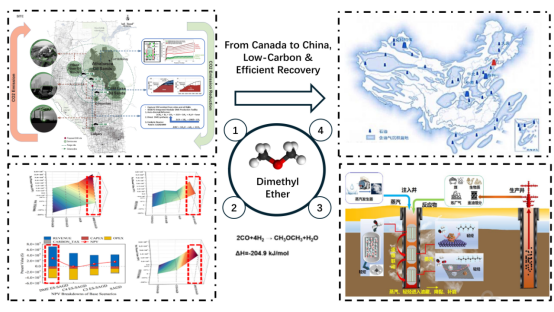
Liaohe to Alberta: A Scholarly Journey
Panjin—widely recognized as China’s “city of heavy oil”—profoundly influenced the early academic path of Dr. Maojie Chai. Following his undergraduate studies, he pursued advanced research in Canada, a global center for heavy oil innovation. There, under the supervision of Academician Professor Zhangxing Chen, he specialized in reservoir numerical simulation, laying the foundation for his subsequent contributions to low-carbon heavy oil recovery.
Research Breakthroughs in Green Solvent Technology
As climate change accelerates, the heavy oil industry faces the dual challenge of meeting global energy demand while reducing carbon emissions. During his doctoral studies, Dr. Maojie Chai investigated the potential of dimethyl ether (DME) as a green solvent for heavy oil recovery. Despite limited data in the early stages, his research achieved several breakthroughs: 1)Elucidating the asymmetric phase behavior of DME–water systems and uncovering the mechanism of enhanced oil–water mass transfer and flow;2)Developing a novel semi-component in-situ upgrading and solid-phase simulation approach; 3)Establishing an integrated “enhanced flow–in-situ upgrading–efficient recovery” framework. These advances overcame the limitations of single-phase mass transfer and conventional compositional models. His findings were highlighted in Energy, a leading international journal, which recognized the work as a milestone in solvent-based enhanced oil recovery.
Beyond academic contributions, Dr. Chai collaborated with industry partners to advance near-zero-carbon DME synthesis, enabling cleaner and more efficient production. His achievements earned direct sponsorship from the Canadian Energy Regulator, making him the first PhD student to lead a national DME project.
Returning to China: Story to be continued
With the recommendation of Professor Xianzhi Song, Dr. Maojie Chai is returning to China and will soon join the China University of Petroleum (Beijing). In collaboration with Professor Yiqiang Li, he is leading a $3 million project that investigates multi-chemical reactions within wellbores, aiming to generate green solvents underground and thereby greatly reduce CO2 emissions in heavy oil recovery. His green solvent research was recognized by China’s Ministry of Education as an outstanding achievement in the 20th Anniversary “Chunhui Program” and was showcased at the National Exhibition and Convention Center in Shanghai, Dec, 2025.
A Vision for the Future
“Grateful for the guidance along the way, my research began with a single small molecule,” the young Professor Maojie Chai said with a smile. “Perhaps this green solvent could reshape the future of heavy oil toward a greener transition.”